

New Releases:

HIGHLIGHTS
Fiber-optic upgrades require scarce germanium
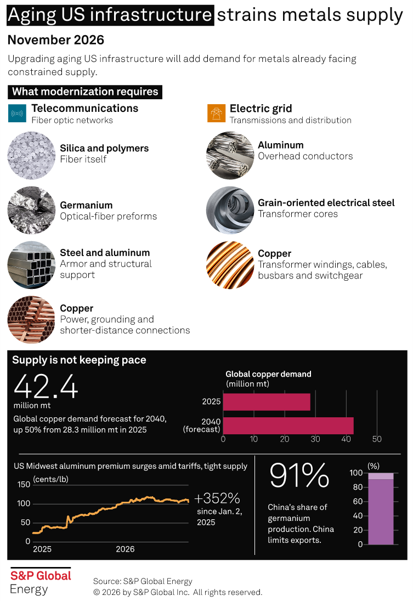
China controls 91% of germanium production
Copper demand projected to rise 50% by 2040
An overhaul of aging US power and telecommunications infrastructure will require metals from supply chains already stretched or heavily dependent on China, industry executives and analysts told Platts, part of S&P Global Energy.
A Nov. 13 telecommunications failure forced the Federal Aviation Administration to suspend flight departures nationwide for more than four hours, causing widespread cancellations and delays, throwing the challenge into focus. The disruption was triggered by contractors replacing parts of the agency’s legacy copper network with high-speed fiber.
"The US air traffic control system relies on millions of cathode ray tubes, which are essentially 1950s-era technology,” Robert Friedland, founder and executive co-chairman of Ivanhoe Mines, told Platts. “It is like the US electrical grid, like an old lady waiting in bed to die of old age.”
Modernizing those systems will require more than new communications equipment. Fiber-optic networks depend on germanium, while power lines, transformers and substations consume copper, aluminum and grain-oriented electrical steel.
“The scale of the works required for an energy transition and renewed generation, transmission and utilization of energy in the USA and Europe is beyond popular imagination, let alone what this implies for mining and metals demand,” Friedland said.
Fiber networks face concentrated germanium supply
Fiber-optic cables are primarily made from silica and polymers, but germanium dioxide is added to help transmit data over long distances. Copper, aluminum, and steel are used for power supply, grounding, reinforcement, and protective components.
S&P Global Horizons estimates fiber optics will be the largest end-use market for germanium, consuming about 142 metric tons of contained metal in 2026, with demand reaching 153 mt in 2030. Substitution remains difficult because germanium’s optical properties are hard to replicate.
China accounted for 91% of primary germanium production in 2025. Production capacity outside China was just 31 mt, though proposed projects in Canada, the US and South Korea could add 95 mt by 2029. Even if those projects are completed, planned capacity would cover only about 48% of demand outside China in 2030, according to S&P Global figures.
China imposed export licensing requirements on germanium in 2023 and later restricted shipments to the US, putting further pressure on an already small market.
The supply squeeze has contributed to a steep US premium: 99.99% germanium in US warehouses was priced at $7,275/kg on Nov. 4, compared with $3,903.79/kg for higher-purity 99.999% material in China’s domestic market, according to a Shanghai Metal Market benchmark as reported by Rare Earth Mining news.
That concentration matters because germanium is difficult to replace in some applications and accounts for a relatively small portion of the cost of finished equipment. Buyers therefore have room to absorb sharply higher prices before curbing demand, said Nick Trickett, head of short-term analytics for critical minerals and metals at S&P Global Energy Horizons.
“If supply is short ex-China, the premiums would naturally shoot higher,” Trickett said. “Since it’s such a small market and typically a small share of end-unit cost, the price can really rocket before you get a meaningful supply response.”
The copper challenge
The scale is far greater for the electric grid. The US needs to replace aging transformers, substations and transmission lines just as electricity consumption is being pushed higher by data centers, manufacturing and electrification.
“We have infrastructure that needs to be redeveloped around the world from the baby-boomer era that was built in the ’40s and the ’60s,” Ivan Bebek, CEO of Coppernico Metals, told Platts. “We need to transfer more energy because the new world requires tons more energy. So copper is at the top of the list, but so are many other critical metals.”
Copper is used extensively in transformers, cables, busbars and switchgear, while aluminum dominates overhead transmission conductors and grain-oriented electrical steel is used in transformer cores.
Global copper demand is expected to rise about 50% to roughly 42 million mt by 2040, according to a January report from S&P Global Energy and S&P Global Market Intelligence. The annual supply shortfall could reach 10 million mt, almost one-quarter of projected demand, even as recycled copper use more than doubles.
New copper mines take about 17 years on average to move from discovery to production, making infrastructure investment increasingly dependent on decisions about permitting, processing, recycling and new mine development made years in advance.
“Meeting future demand will require the development of a significant number of new mines, particularly to secure sufficient copper supply, one of the backbone minerals of electrification,” Friedland said.
The US also cannot rely on domestic production alone. Infrastructure construction is likely to move faster than new mines, smelters and refineries can be developed, Trickett said.
“Imports will meet a majority of any marginal demand for bulk materials that go into these projects, things like aluminum and copper,” he said.
Would you like to learn more?
Author: Liubov Georges | liubov.georges@spglobal.com
© 2026 by S&P Global Energy, a division of S&P Global Inc. All rights reserved.
S&P Global, the S&P Global logo, S&P Global Energy, Platts, and Fertecon are trademarks of S&P Global Inc. Permission for any commercial use of these trademarks must be obtained in writing from S&P Global Inc.
You may view or otherwise use the information, prices, indices, assessments, content, analysis and other related information, graphs, tables and images (collectively, “Data”) in this report only for your personal and internal use or, if you or your company has a license for the Data from S&P Global Energy (“SPGE”) and you are an authorized user, for your company’s internal business use only. You may not publish, reproduce, extract, distribute, retransmit, resell, create any derivative work from and/or otherwise provide access to the Data or any portion thereof to any person (either within or outside your company, including as part of or via any internal electronic system or intranet), firm or entity, including any subsidiary, parent, or other entity that is affiliated with your company, without SPGE’s prior written consent or as otherwise authorized under license from SPGE. Any use or distribution of the Data beyond the express uses authorized in this paragraph is subject to the payment of additional fees to SPGE.
SPGE, its affiliates and all of their third-party licensors (i) disclaim any and all warranties, express or implied, including, but not limited to, any warranties of merchantability or fitness for a particular purpose or use as to the Data, or the results obtained by its use or as to the performance thereof; (ii) do not guarantee the adequacy, accuracy, timeliness and/or completeness of the Data or any component thereof or any communications (whether written, oral, electronic or other format), with respect thereto, and (iii) shall not be subject to any damages or liability, including but not limited to any indirect, special, incidental, punitive or consequential damages (including but not limited to, loss of profits, trading losses and loss of goodwill).
Data in this report includes independent and verifiable data collected from actual market participants. Users of the Data should not rely on any information and/or assessment contained therein in making any investment, trading, risk management or other decision.
ICE index data and NYMEX futures data used herein are provided under SPGE’s commercial licensing agreements with ICE and with NYMEX. You acknowledge that the ICE index data and NYMEX futures data herein are confidential and are proprietary trade secrets and data of ICE and NYMEX or its licensors/suppliers, and you shall use best efforts to prevent the unauthorized publication, disclosure or copying of the ICE index data and/or NYMEX futures data.
The Data in this report contains the results of SPGE’s independent research and analysis and is intended for general informational purposes only. The Data is not intended, and may not be used, to promote, directly or indirectly, the supply or use of any product or business interest, including, but not limited to, the benefits of any product, business, or business activity for protecting or restoring the environment or mitigating the causes or effects of climate change. No Data or opinions contained herein constitute a representation to the public with respect to the benefits of any product, business or business activity, and should not be relied on as a recommendation for any specific action to be taken.
Any queries or requests pursuant to this notice should be addressed to SPGE via email at Legalnotices.energy@spglobal.com