


Dr. Ghassan Zubi
Project Manager
-
HyStandards (Germany)
The global race to decarbonize aviation is entering a decisive phase. While conventional Sustainable Aviation Fuel (SAF) offers a vital near-term bridge as a drop-in hydrocarbon, the industry’s long-term net-zero ambitions demand a fuel that is not only carbon-free but also scalable, cost-competitive, and independent of biomass constraints.
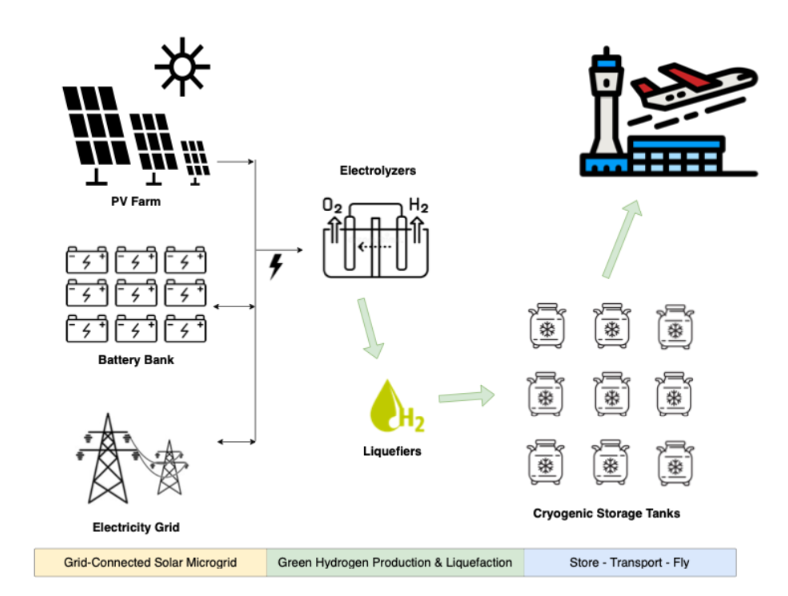
For the sun-rich nations of the Middle East and North Africa (MENA), the future of clean flying is written not only in the skies, but also on the ground through renewable energy and hydrogen. Liquid Green Hydrogen (LGH), produced from water using vast solar energy, represents a paradigm shift—a truly sustainable aviation fuel whose scalability is limited only by sunlight and engineering ambition. With its world-leading solar resources, existing aviation hub status, and forward-looking industrial strategy, the UAE is uniquely positioned to pilot this integrated value chain—from gigawatt-scale solar plants to cryogenic fuel loading at airport gates.
Two major issues challenge our vision of hydrogen-powered aviation: compared to conventional jet fuel and jet engines, liquid hydrogen has a low volumetric energy density, and aviation fuel cells have a low specific power. However, these are not dead ends, but rather engineering challenges with clear innovation roadmaps. The response is taking shape through parallel revolutions in airframe design and propulsion technology.
The low volumetric energy density of liquid hydrogen means that aircraft need significantly larger fuel tanks, while also the fuel economy needs to improve. The industry’s most promising answer is the Blended Wing Body (BWB) design, actively pursued by major manufacturers and ambitious start-ups. This fundamental redesign transforms a volumetric challenge into an opportunity for greater efficiency. By merging the fuselage and wings into a single, wide lifting body, the BWB creates a much larger internal volume for cryogenic hydrogen tanks while improving the aircraft aerodynamics. The BWB design can improve overall fuel economy by up to 20%, partially offsetting hydrogen's inherent range penalty.
While hydrogen can be combusted in modified gas turbines-a more straightforward transition-the greater long-term efficiency prize lies in hydrogen fuel cells with electric propulsion. The challenge, as noted, is specific power. Today’s aviation-grade fuel cell systems are too heavy for mainstream commercial flight. Yet, the industry roadmap is aggressive and focused. Research is targeting High-Temperature PEM fuel cells (HT-PEMFC) with simpler thermal and water management, enabling a lighter design. The goal is to achieve a system-level specific power exceeding 3 kW/kg by 2035, a key threshold for making regional aircraft commercially viable. For longer ranges, hybrid propulsion architectures—such as integrating fuel cells with hydrogen gas turbines—are under investigation. These systems aim to exploit the high efficiency of fuel cells during cruise while using turbines to support high-power phases.
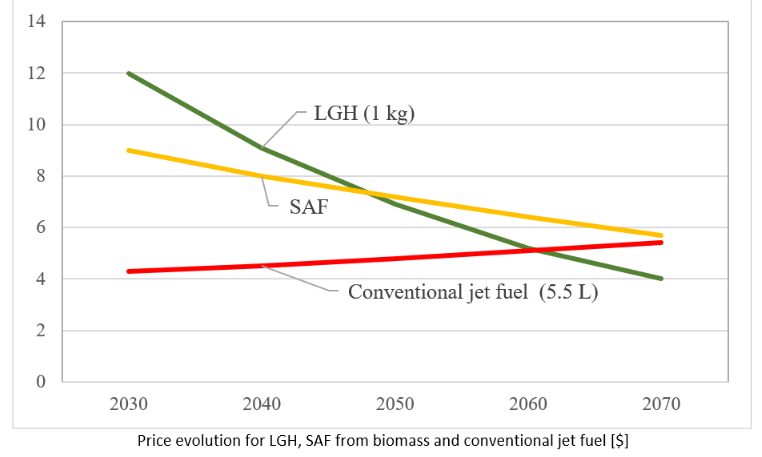
These parallel advancements represent the most promising pathway to closing the performance gap. If these technological and infrastructure challenges are met, hydrogen-powered flights over distances of 5,000+ km could become a commercial reality by the 2040s. This technological pathway represents a strategic investment in the future of sustainable aviation—a future where energy security and climate leadership are intertwined. In the UAE, LGH will become more cost efficient than SAF from biomass by 2050 and cheaper than conventional jet fuel by 2060.
To realize the vision of a sun-powered aviation future, a coordinated, multi-stakeholder strategy is essential.
The following policy measures are critical to de-risk investment, accelerate innovation, and position the UAE—and the wider MENA region—as the leading hub for green aviation fuel:
1. Accelerate Renewable Energy & Electrolysis Scale-Up
Fast-track permitting and incentives for utility-scale solar PV and wind projects dedicated to green hydrogen production.
Launch public-private R&D initiatives focused on reducing the capital cost and improving the efficiency of gigawatt-scale electrolyzers.
2. Build the End-to-End Liquid Hydrogen Infrastructure
Develop national master plans for LH₂ production, storage, and transportation, identifying optimal locations for coastal export hubs and inland airport supply corridors.
Foster strategic partnerships between energy companies, airports, and logistics firms to finance and deploy the first generation of LH₂ bunkering and refueling infrastructure.
3. Establish Credible Standards and Certification
Work with international bodies (ICAO, IATA) to define and harmonize global standards for LH₂ as an aviation fuel, covering safety, handling, and aircraft fueling protocols.
Implement a transparent, digital “green hydrogen” certification scheme to guarantee the renewable origin of hydrogen and unlock premium markets.
4. Secure Critical Materials and Foster Circularity
Commission detailed supply-chain studies to map and quantify potential bottlenecks for critical materials (e.g., iridium for electrolyzers, platinum for fuel cells).
Develop industrial strategies to promote recycling, material substitution, and circular economy principles within the clean hydrogen and aviation manufacturing sectors.
5. Enable Market Creation and Early Adoption
Introduce contracts-for-difference (CfD) schemes or offtake guarantees to support first-mover LH₂ production plants and provide revenue certainty for investors.
Implement sustainable aviation fuel (SAF) mandates that explicitly recognize and incentivize green hydrogen-derived fuels (e.g., liquid hydrogen and power-to-liquid synthetics) to create early demand.
By acting on this blueprint, the UAE can catalyze a new industrial ecosystem—turning abundant sunlight into the clean molecules that will power global aviation into a sustainable future.
Dr. Ghassan Zubi is a Project Manager at HyStandards (Germany) and a Renewable Energy & Sustainability Consultant, with expertise in hydrogen, sustainable aviation fuels, and sector decarbonization. Previously, he directed renewable energy R&D at Abu Dhabi’s Technology Innovation Institute and provided policy support for the European Commission's Joint Research Centre. He is also a Guest Editor for the journal Sustainability, leading a special issue on renewable energy and hydrogen technology development.
Contact: ghassanzubi@gmail.com