

Technology Partnerships Can De-Risk a SAF Pathway with a Challenged Past
Christopher Brunn, Low Carbon Fuels BD Manager, Axens
Nicolas Simon, Lead Technology Engineer, Axens
Gasification: A Troubling Past
The consensus opinion of Sustainable Aviation Fuel experts, consultants, and industry projection reports is that one of the long-term SAF growth pillars will be the utilization of abundant, low-cost, waste biomass via the Gasification and Fischer-Tropsch (F-T) pathway. However, the history of that pathway is filled with the remains of unsuccessful commercialization attempts
Those “in the know” understand that the failure of these projects was not the result of poor performance of any one technology, yet the shadow those failures have cast on the Gasification F-T pathway still lingers years later.
The good news here is that the pathway has had a difficult start, but that partnership-led development is essential to reduce integration, scale-up, and execution risk so that it can flourish in the long -term.
Partnering to De-Risk and Make the F-T Pathway an Industrial Reality
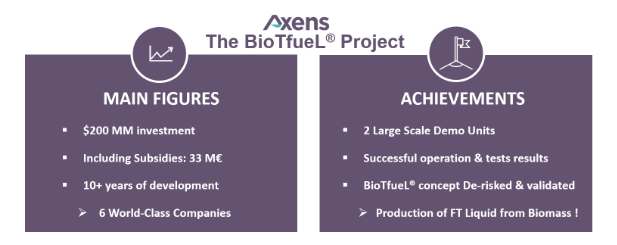
Axens and its parent company, IFP Energies Nouvelles (IFPEN), realized the potential of the Gasification F-T pathway in the early 2000’s and recognized the potential complexity of combining multiple technologies together in a single chain while introducing 100% biomass feedstocks that had not been proven in commercial-scale gasification units before. The Axens and IFPEN teams also realized that partnering would be critical to the success of this pathway and formed the Bionext consortium to develop the BioTfueL® (say it with me now; it’s beautifuel!) technology in 2010, with the guiding principle of rigorously applying their decades-old, robust technology development process to this novel pathway. Over the course of more than a decade, and with investments totaling more than $200MM USD, six world-class partners systematically de-risked biomass gasification, syngas purification, and F-T units, culminating in the construction and successful operation of a large-scale, integrated demonstration plant in Dunkirk, France and a pretreatment plant in Venette, France.
The BioTfueL® Development Project
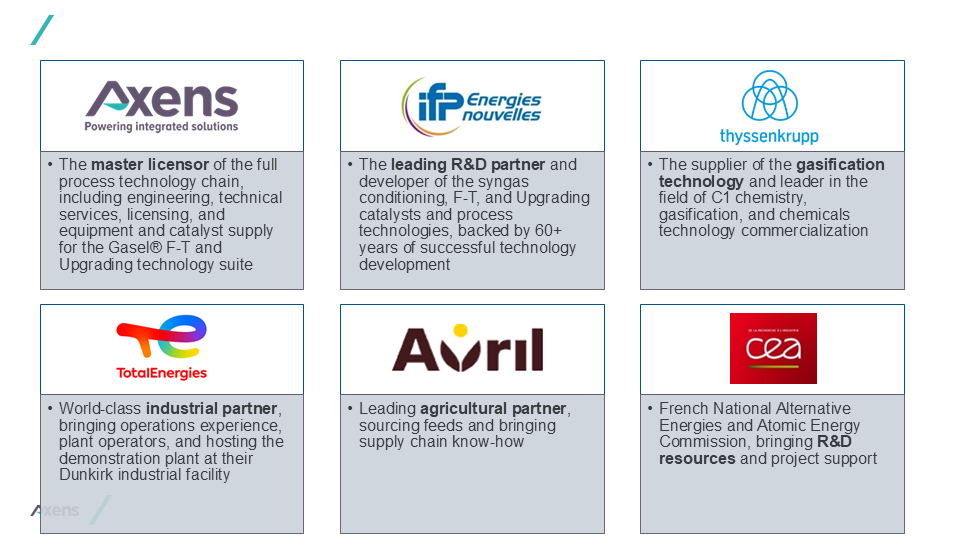
The first step of the collaboration was to form a consortium with complementary strengths, led by world-class industry players:
The partners utilized a long development timeline, significant investment, and a unique pretreatment step to systematically de-risk the full chain of biomass to SAF via gasification and F-T.
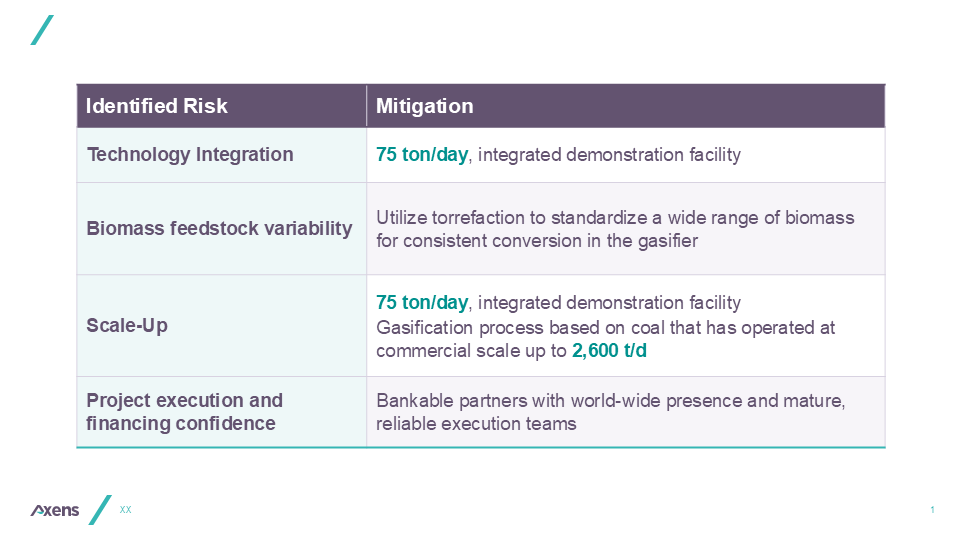
The partners recognized the risks associated with gasifying inherently variable biomass and focused their efforts on mitigating that risk by building upon decades of industrial-scale gasification in a proven industry: coal to power. The philosophy was built by asking a simple question: “what if we lightly roast the biomass so that it has consistent properties, regardless of variability of the biomass feed itself, and, therefore, can we get biomass to behave like coal?” This question led to the concept of pretreating the biomass in a process called torrefaction then grinding it, resulting in a dried, “coal-like” powder, ideal for the Uhde® PRENFLO® gasification process, utilizing entrained-flow, direct quench technology to achieve complete carbon conversion to syngas.
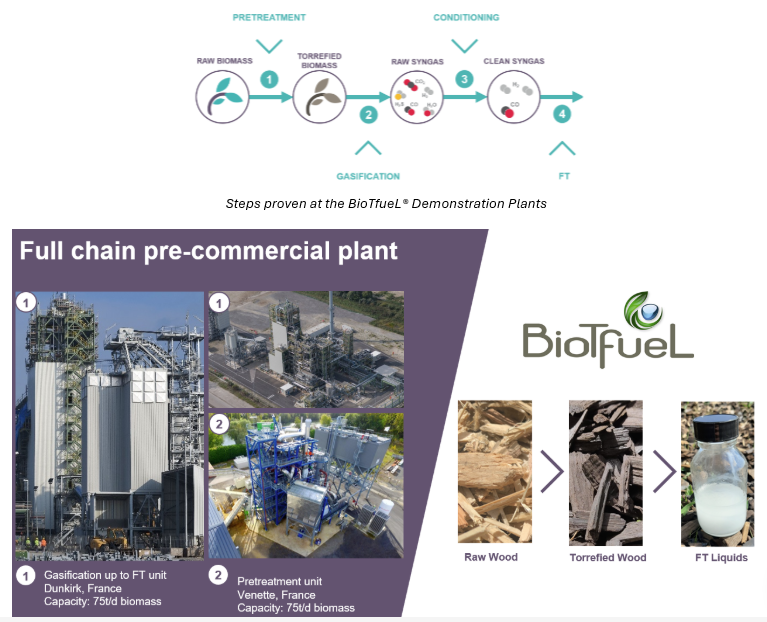
With that innovation, the BioTfueL® process technology was born, and the development focused on proving that concept via operation of the 75 ton per day demonstration facilities, including the process chain from raw biomass to F-T liquids:
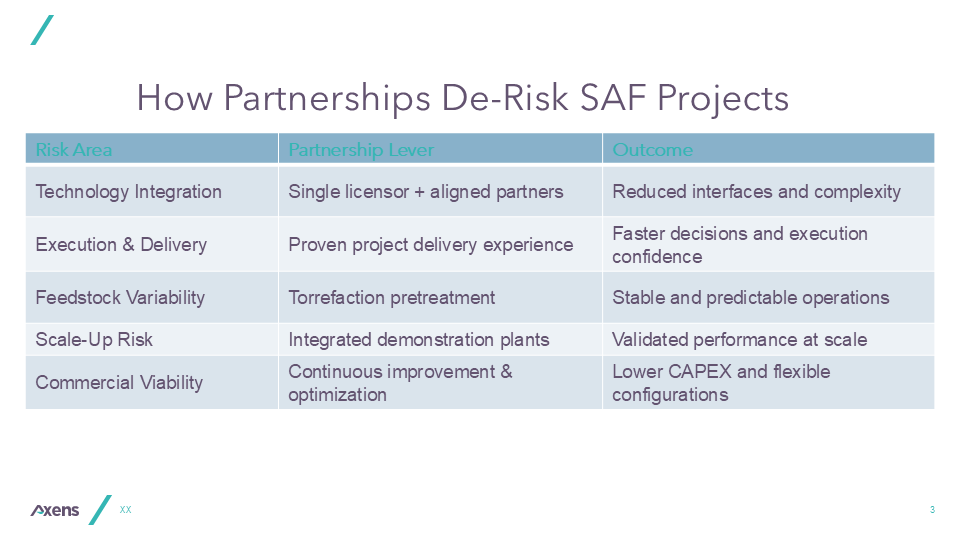
A key element of this approach was the ability to offer an integrated technology package through a single licensor structure, reducing interfaces between providers and therefore lowering complexity on the developer side. This streamlined approach enables faster decision-making, improved consistency across the process design, and ultimately reduces execution timelines.
And now, this collaboration is not just theory and a demonstration plant alone; it’s now backed by extensive project delivery experience, including multiple basic engineering designs and optimization studies that helped translate technology concepts into executable plant designs, including working hand-in-hand with project owners to optimize the entire process chain from biomass to finished fuels.
These process optimizations include options such as:
integration of e-fuel co-production pathways with low-carbon hydrogen,
incorporation of CO₂ management solutions, including sequestration,
flexibility between single-product or multi-product schemes
This combination of integration, standardization, and flexibility also supports CAPEX optimization, a critical factor in enabling commercial deployment at scale.
Partnering Spirit
The BioTfueL® collaboration is a perfect example of Axens DNA and the philosophy that will drive success in the growing SAF industry: be guided by a partnering spirit, utilizing the strengths of each partner.
The result in this case is a bankable, demonstrated, integrated process now licensed by Axens and being deployed in multiple worldwide projects that helps stakeholders overcome past challenges and realize the full potential of the biomass-to-liquids pathway.
This project highlights that successful SAF commercialization in complex pathways depends not just on strong technology, but on partnering spirit that enables effective project delivery, minimizes integration complexity, and continuously improves performance over time.
Learn more about BioTfuel®: https://www.axens.net/expertise/renewable-fuels-bio-based-chemicals/sustainable-aviation-fuel