

Technip Energies, Airbus, Safran form eSAF venture at Dunkirk

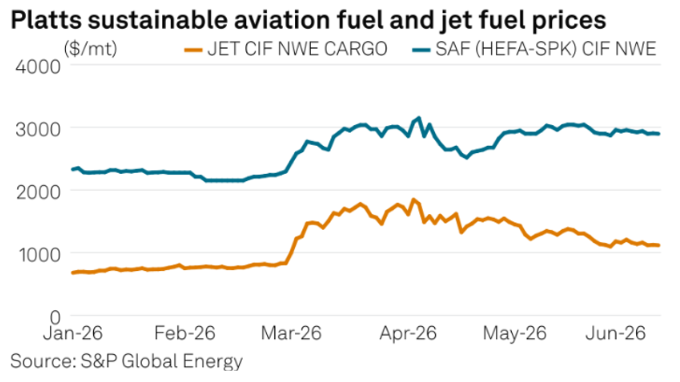
S&P Global Energy Platts – SAF and Jet Fuel Monthly Price Chart:
HIGHLIGHTS
· Joint venture to produce alcohol-to-jet from agricultural residues
· Plant to help meet EU's 6% blending mandate by 2030
· Project strengthens European energy supply security outlook
A consortium of industrial leaders has formed a joint venture to develop one of Europe's largest alcohol-to-jet facilities, aiming to help meet rapidly rising EU mandates and contribute to energy security.
Technip Energies, Airbus, Safran and agricultural cooperative Tereos will establish Rebound to build a plant at the Port of Dunkirk, France, capable of producing 160,000 mt/year of synthetic sustainable aviation fuel, or eSAF, using the alcohol-to-jet pathway, they said in a statement June 9.
The facility will convert advanced ethanol derived from agricultural and forestry residues into drop-in aviation fuel that can be blended with conventional jet fuel.
"Among the available production pathways, Alcohol-to-Jet is emerging as a scalable and cost-competitive option which converts advanced ethanol, produced from agricultural and forestry residues into drop-in aviation fuel that can be blended with conventional jet fuel and used in existing engines and aircraft," the statement said.
The project aims to help address surging European demand for alternative aviation fuel driven by the EU's Refuel EU Aviation regulation, which requires airlines to blend 6% SAF with conventional jet fuel by 2030, rising to 70% by 2050. Alongside this, eSAF must account for 1.2% of aviation fuel supplied by 2030 and 35% by 2050.
That regulatory framework is expected to drive an eightfold increase in SAF demand between 2030 and 2050, the statement said. Additionally, it aims to strengthen Europe's energy supply security, the statement said.
Roadblocks
Scaling alcohol-to-jet fuel technology at commercial levels will be critical to meeting near-term sustainable aviation fuel supply targets, with ethanol feedstock availability expected to increase substantially by the end of the decade, an official at the International Air Transport Association said June 3.
There are 64 announced large-scale projects worldwide, with 26 due to be operational by 2030, driven by ReFuelEU and the UK SAF mandates, according to lobby group Transport & Environment. If all the announced large-scale projects become operational, global production capacity could reach 2.1 million mt by 2030, and 5 million mt in total, accounting for roughly 10% of EU jet fuel demand, T&E said.
However, to T&E's knowledge, except for Infinium's Project Roadrunner in the US, none of these projects have reached FID, and timelines remain uncertain, T&E said on its website June 9.
Analysts at S&P Global Horizons forecast a global alcohol-to-jet supply of 46,692 mt in 2026, rising to 1.270 million in 2030, of which Europe will account for none. Horizons projects European alcohol-to-jet production will start in 2031 at 22,653 mt/year and rise from there, they said in a May 2026 long-term outlook.
Levelized costs of production for eSAF will be $7,471/mt in 2026 and $6,213/mt in 2030, compared to $588/mt and $624/mt for jet fuel on a CIF basis in Northwest Europe, Horizons analysts said in a March 2026 forecast.
Strategic positioning
Steps ahead for the Rebound project include the selection of the technology licensor, permitting activities, launch of pre-FEED (Front-End Engineering Design) and FEED activities, finalization of feedstock supply and offtake agreements, and securing the financing for the construction of the asset, the companies said.
"The creation of the joint venture is subject to customary closing conditions and approvals and is expected to be finalised in the second half of this year," they said.
Tereos will supply the advanced ethanol feedstock, creating an integrated value chain from agricultural production to aviation end-use.
The Port of Dunkirk has awarded Technip Energies an industrial site in northern France, offering logistical advantages for feedstock delivery and product distribution. The location provides streamlined permitting and access to existing port infrastructure for both imports and exports.
The alcohol-to-jet pathway is an alternative production route to the established hydroprocessed esters and fatty acids route and Fischer-Tropsch synthesis. The technology converts ethanol into jet fuel through dehydration, oligomerization and hydrogenation processes.
Would you like to learn more?
© 2026 by S&P Global Energy, a division of S&P Global Inc. All rights reserved.
S&P Global, the S&P Global logo, S&P Global Energy, Platts, and Fertecon are trademarks of S&P Global Inc. Permission for any commercial use of these trademarks must be obtained in writing from S&P Global Inc.
You may view or otherwise use the information, prices, indices, assessments, content, analysis and other related information, graphs, tables and images (collectively, “Data”) in this report only for your personal and internal use or, if you or your company has a license for the Data from S&P Global Energy (“SPGE”) and you are an authorized user, for your company’s internal business use only. You may not publish, reproduce, extract, distribute, retransmit, resell, create any derivative work from and/or otherwise provide access to the Data or any portion thereof to any person (either within or outside your company, including as part of or via any internal electronic system or intranet), firm or entity, including any subsidiary, parent, or other entity that is affiliated with your company, without SPGE’s prior written consent or as otherwise authorized under license from SPGE. Any use or distribution of the Data beyond the express uses authorized in this paragraph is subject to the payment of additional fees to SPGE.
SPGE, its affiliates and all of their third-party licensors (i) disclaim any and all warranties, express or implied, including, but not limited to, any warranties of merchantability or fitness for a particular purpose or use as to the Data, or the results obtained by its use or as to the performance thereof; (ii) do not guarantee the adequacy, accuracy, timeliness and/or completeness of the Data or any component thereof or any communications (whether written, oral, electronic or other format), with respect thereto, and (iii) shall not be subject to any damages or liability, including but not limited to any indirect, special, incidental, punitive or consequential damages (including but not limited to, loss of profits, trading losses and loss of goodwill).
Data in this report includes independent and verifiable data collected from actual market participants. Users of the Data should not rely on any information and/or assessment contained therein in making any investment, trading, risk management or other decision.
ICE index data and NYMEX futures data used herein are provided under SPGE’s commercial licensing agreements with ICE and with NYMEX. You acknowledge that the ICE index data and NYMEX futures data herein are confidential and are proprietary trade secrets and data of ICE and NYMEX or its licensors/suppliers, and you shall use best efforts to prevent the unauthorized publication, disclosure or copying of the ICE index data and/or NYMEX futures data.
The Data in this report contains the results of SPGE’s independent research and analysis and is intended for general informational purposes only. The Data is not intended, and may not be used, to promote, directly or indirectly, the supply or use of any product or business interest, including, but not limited to, the benefits of any product, business, or business activity for protecting or restoring the environment or mitigating the causes or effects of climate change. No Data or opinions contained herein constitute a representation to the public with respect to the benefits of any product, business or business activity, and should not be relied on as a recommendation for any specific action to be taken.
Any queries or requests pursuant to this notice should be addressed to SPGE via email at Legalnotices.energy@spglobal.com