

Asia-Pacific is set to shape the next phase of the global sustainable aviation fuel (SAF) market. According to SkyNRG, the region has overtaken the United States as the largest source of announced SAF production capacity and is the world's fastest-growing aviation region. Producing countries are moving up the value chain, refining feedstock at home and exporting fuel rather than raw materials: Indonesia restricts exports of crude palm oil mill effluent (POME) and used cooking oil (UCO), China has removed export tax incentives on UCO, and Malaysia is considering similar measures.
Whether this rapid expansion becomes lasting leadership will depend on three levers (feedstock potential, policy frameworks and cross-border trade partnerships) and on one condition that ties them together: environmental attributes that buyers trust wherever the fuel is sold.
Feedstock potential: the starting point
Feedstock alone does not make a leader. How it is used does. The resource base is substantial: the Roundtable on Sustainable Biomaterials estimates that sustainable feedstock in Southeast Asia alone could support around 45.7 million tonnes of SAF a year by 2050, equivalent to around 12% of the roughly 380 million tonnes of SAF needed globally to reach net-zero aviation. Today, waste oils and fats are the main source, but SkyNRG estimates that local supply could support only around 8 million tonnes of HEFA-based SAF a year by 2035, short of the region’s projected demand.
That base is growing. In late 2025, ICAO endorsed a CORSIA default life-cycle value of 18.1 gCO₂e/MJ for POME-based SAF. This opens a new pathway from palm residues, with emissions reductions of up to 80%, and Indonesian authorities see it as a route to becoming a competitive SAF supplier in Asia.
Beyond lipids, the potential is greater still. Rice straw, bagasse, cassava residues, forestry residues and municipal waste can feed advanced pathways. These routes are not yet proven at commercial scale: HEFA remains the only pathway operating at scale today, and alcohol-to-jet and Fischer-Tropsch projects have so far progressed slowly. India alone reports around 230 million tonnes of surplus agricultural residue. Australia exports nearly A$4 billion of suitable feedstocks such as canola and tallow, which are mostly refined overseas. Processing them at home could support a domestic low-carbon liquid fuels industry that the Clean Energy Finance Corporation estimates could be worth A$36 billion by 2050.
This diversity is the region's real advantage. The leaders will be those who match the right feedstock with the right technology and the right market, building a portfolio that sustains production, and returns, long after today’s waste-oil supply is fully committed.
Policy frameworks: turning potential into bankable demand
A producer earns a return only if someone commits to buying SAF at a premium over fossil jet fuel. Policy provides that commitment and settles who pays for it. Across the region, frameworks are moving from roadmaps to binding instruments.
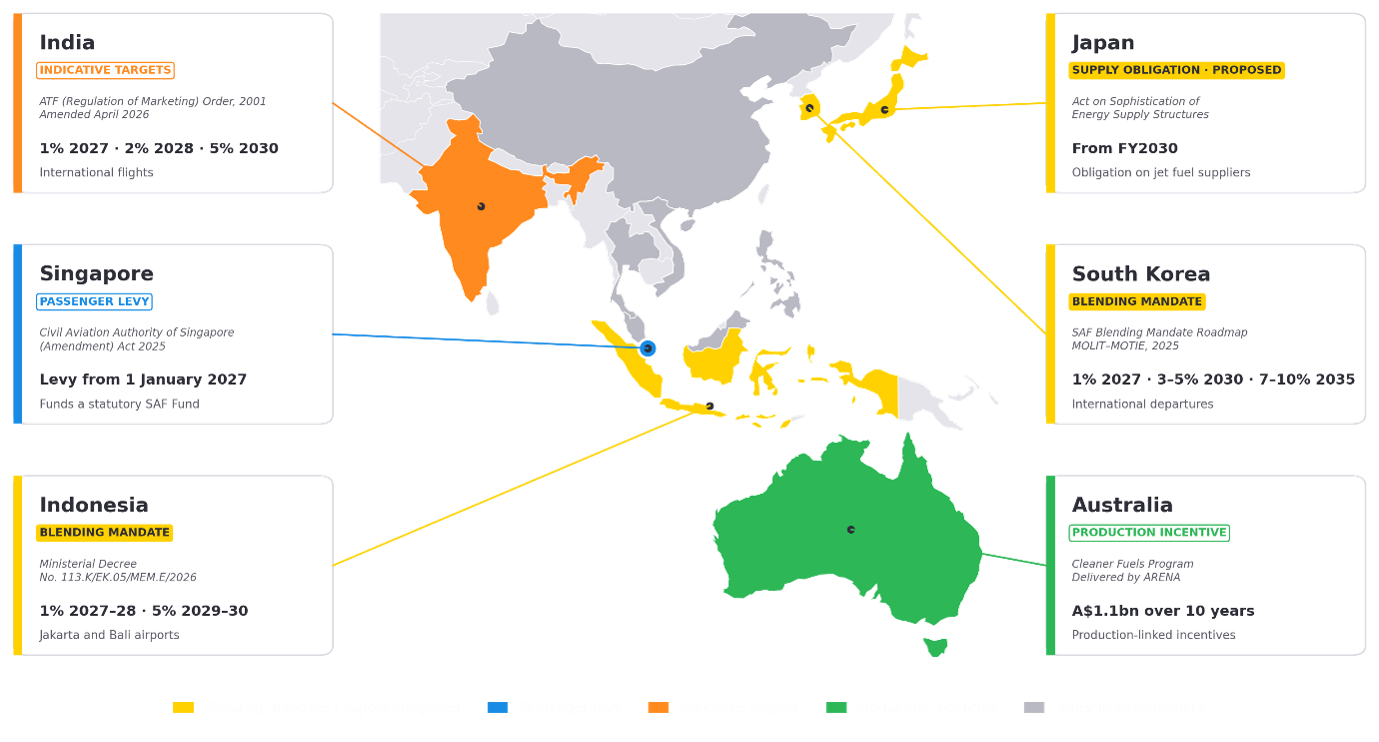
Each market is choosing a different instrument: a passenger levy in Singapore, blending mandates in South Korea and Indonesia, indicative targets in India, a proposed supply obligation in Japan and production incentives in Australia. The design matters as much as the target, because it determines how the cost is shared and which projects reach final investment decision.
The countries that turn targets into enforceable, well-funded mechanisms first will attract the capital and capacity that follow.
Cross-border trade partnerships: taking value to market
Trade decides where the region’s resources earn their value. Feedstock sits in one jurisdiction, refining capacity in another and much of the compliance demand in a third, often Europe. No single player controls every link in that chain.
Competitive advantage is shifting from owning assets to securing access: to feedstock, to offtake and to the markets where SAF earns its premium. Cross-border partnerships are how that access is built. Established energy companies are taking positions alongside regional producers rather than building alone, as TotalEnergies has done with Sinopec. Airlines and manufacturers are investing upstream to secure future supply, as Airbus and Cathay have done with up to US$70 million. Multilateral platforms such as ICAO’s Finvest Hub are bringing projects and capital together.
The players best placed to lead are those who can partner across borders as effectively as they produce at home.
Returns: value that travels across borders
The premium a buyer pays for SAF rewards its environmental attribute. Airlines buy SAF to meet mandates, to reduce offsetting obligations as CORSIA’s mandatory phase begins in 2027, and to deliver on Scope 3 targets for themselves and their customers. That premium reaches the producer only if the attribute is accepted in the market where it is claimed. A tonne of SAF that cannot prove its origin and carbon intensity sells at the price of fuel. One that can earns the price of decarbonisation.
Allegations of fraud in imported waste-based biofuels, including those made from UCO, have led the European Commission to identify weaknesses in certification audits, and palm-derived residues face continued scrutiny over sustainability and traceability. Capturing that premium comes down to three conditions: authenticity, auditability and acceptability.
Singapore shows how this can work in practice. Its national SAF company will manage environmental attributes separately from the physical fuel, transparently and in line with CORSIA standards. Credible chain of custody, certification and accounting are therefore more than a compliance cost. They are what allows the region’s value to travel with every cross-border trade.
Leading the next phase
Asia-Pacific has the feedstock potential, the growing policy frameworks and the trade relationships to lead the global SAF market. Leadership will go to those who connect them. Three questions are worth asking at board level:
Feedstock: Is your strategy built on the full regional resource base, and eligible in every market you plan to serve?
Policy: Are your projects designed around the instruments that will make demand bankable?
Partnerships: Can your partnerships, and your environmental attributes, move value across borders with confidence?
The answers will decide who turns the region’s resources into returns.