

New Releases:
Hong Kong plan sets 1%-3% SAF target for departing flights by 2030 | S&P Global
China launches 100,000 mt/year negative-carbon SAF project in Xinjiang | S&P Global
Shougang Langze, Sinopec units team up on 50,000 mt/y China SAF project | S&P Global
India scores 52% on SAF readiness as demand, financing lag feedstock potential: RSB | S&P Global
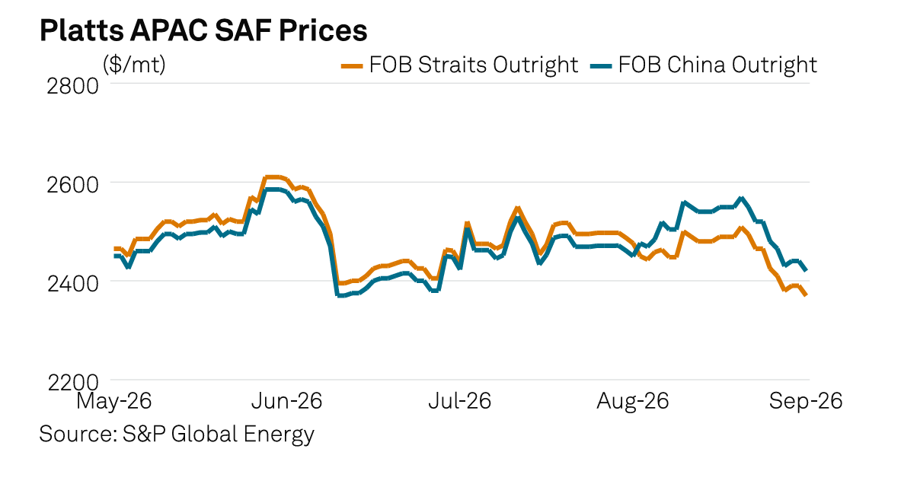
S&P Global Energy Platts – APAC SAF Monthly Price Chart
HIGHLIGHTS
Coprocessing capacity covers 2027-28 demand
Standalone plants need funding for 2030 goal
Jet fuel consumption grows 45% through 2031
India possesses sufficient domestic refinery coprocessing capacity to fulfill its initial sustainable aviation fuel blending mandates starting in 2027, but scaling up to meet the country's 5% target by 2030 will require urgent investment in stand-alone commercial plants and feedstock collection infrastructure, according to a joint report released Sept. 28 by S&P Global Energy and the SAF Association.
The report, titled "India's Strategy for SAF Leadership: From Policy to Implementation," outlines India's road map for international flights, which sets indicative blending targets of 1% in 2027, 2% in 2028, and 5% by 2030.
Under this trajectory, Indian SAF demand is projected to rise from about 46,000 metric tons in 2027 to roughly 250,000 mt by 2030.
India's overall jet fuel consumption is expected to be among the fastest-growing globally, expanding nearly 45% from 192,000 barrels/day (b/d) in 2024 to 277,000 b/d by 2031, the report said.
Refining assets secure near-term compliance
India's immediate compliance strategy relies heavily on refinery coprocessing via the hydroprocessed esters and fatty acids pathway.
It hosts four ISCC-CORSIA certified coprocessing facilities with a combined annual capacity of 106,500 mt: Bharat Petroleum Corp. Ltd.'s Mumbai refinery with 61,000 mt capacity, Indian Oil Corp. Ltd's in Panipat refinery with 30,000 mt, Hindustan Petroleum Corp. Ltd.'s Visakh refinery with 10,000 mt, Mangalore Refinery and Petrochemicals Ltd.'s Katipalla refinery with 5,500 mt.
This existing coprocessing volume is sufficient to cover the mandatory SAF demand for 2027 and 2028, the report said.
Meeting the 2030 demand of 250,000 mt, however, will depend on planned greenfield HEFA and Alcohol-to-Jet projects coming online between 2028 and 2030. Achieving the 1% target in 2027 is estimated to reduce greenhouse gas emissions by 119,000 mt, expanding to 665,000 mt in emissions reductions by 2030.
"The question before us is no longer whether India has an SAF opportunity, but how effectively we can convert that opportunity into a scalable, sustainable and globally competitive industry," Rohit Kumar, Secretary General of the SAF Association, said.
Feedstock fundamentals and export bottlenecks
India holds substantial domestic feedstock potential, supported by annual edible oil consumption of 29 million-30 million mt, which could yield between 1.8 million-2.6 million mt of used cooking oil annually, according to the report.
However, only a fraction of this volume is collected through formal, traceable supply chains.
For the ATJ pathway, India's established sugarcane and molasses ethanol capacity, providing 1.5 billion liters to the domestic E20 gasoline blending program, presents a structural advantage, the report said.
Sugarcane-based ATJ can achieve up to a 73% greenhouse gases reduction compared to standard Jet-A1 under ICAO default values.
However, the report highlights potential barriers to international export markets.
EU feedstock restrictions under ReFuelEU Aviation rules, food and crop-based feedstocks (including sugarcane ethanol) are excluded. Moreover, Indian ATJ producers seeking to export to European markets will need to pivot toward second-generation (2G) cellulosic ethanol and agricultural residues. Meanwhile, domestic coprocessing assets are CORSIA-certified but require additional EU sustainability certifications for broader market entry.
Phased technology road map
The report recommends a three-phase technological sequence for India.
A near-term phase for HEFA assets and refinery coprocessing for CORSIA compliance; a medium-term step to leverage existing ethanol infrastructure, and a long term one to deploy Fischer-Tropsch processing for municipal solid waste and agricultural residues, along with e-SAF linked to India's national mission.
"SAF must be viewed not as a single technology or feedstock pathway, but as a portfolio of opportunities aligned with India's diverse resources," said Alok Sharma, Vice President of the SAF Association and former Director of R&D at IOCL. "Projects must move beyond announcements toward bankable investments and commercial production."
Market context and green premiums
Global SAF prices continue to hold a steep premium over conventional jet fuel, driven by compliance mandates, feedstock constraints, and geopolitical risks in key shipping corridors.
At the end of first-half 2026, Platts assessed FOB Straits SAF outright values at $2,435/metric ton and FOB China SAF at $2,410/mt.
In feedstock markets, standard UCO FOB North China was assessed at $1,140/mt on April 2, 2026.
Platts, part of S&P Global Energy, assessed SAF (HEFA-SPK) FOB Straits at $2,440/mt on Sept. 25, up $10 day over day.
Would you like to learn more?
Author: Samyak Pandey | samyak.pandey@spglobal.com
Editor: Sarah Mishra | sarah.mishra@spglobal.com
© 2026 by S&P Global Energy, a division of S&P Global Inc. All rights reserved.
S&P Global, the S&P Global logo, S&P Global Energy, Platts, and Fertecon are trademarks of S&P Global Inc. Permission for any commercial use of these trademarks must be obtained in writing from S&P Global Inc.
You may view or otherwise use the information, prices, indices, assessments, content, analysis and other related information, graphs, tables and images (collectively, “Data”) in this report only for your personal and internal use or, if you or your company has a license for the Data from S&P Global Energy (“SPGE”) and you are an authorized user, for your company’s internal business use only. You may not publish, reproduce, extract, distribute, retransmit, resell, create any derivative work from and/or otherwise provide access to the Data or any portion thereof to any person (either within or outside your company, including as part of or via any internal electronic system or intranet), firm or entity, including any subsidiary, parent, or other entity that is affiliated with your company, without SPGE’s prior written consent or as otherwise authorized under license from SPGE. Any use or distribution of the Data beyond the express uses authorized in this paragraph is subject to the payment of additional fees to SPGE.
SPGE, its affiliates and all of their third-party licensors (i) disclaim any and all warranties, express or implied, including, but not limited to, any warranties of merchantability or fitness for a particular purpose or use as to the Data, or the results obtained by its use or as to the performance thereof; (ii) do not guarantee the adequacy, accuracy, timeliness and/or completeness of the Data or any component thereof or any communications (whether written, oral, electronic or other format), with respect thereto, and (iii) shall not be subject to any damages or liability, including but not limited to any indirect, special, incidental, punitive or consequential damages (including but not limited to, loss of profits, trading losses and loss of goodwill).
Data in this report includes independent and verifiable data collected from actual market participants. Users of the Data should not rely on any information and/or assessment contained therein in making any investment, trading, risk management or other decision.
ICE index data and NYMEX futures data used herein are provided under SPGE’s commercial licensing agreements with ICE and with NYMEX. You acknowledge that the ICE index data and NYMEX futures data herein are confidential and are proprietary trade secrets and data of ICE and NYMEX or its licensors/suppliers, and you shall use best efforts to prevent the unauthorized publication, disclosure or copying of the ICE index data and/or NYMEX futures data.
The Data in this report contains the results of SPGE’s independent research and analysis and is intended for general informational purposes only. The Data is not intended, and may not be used, to promote, directly or indirectly, the supply or use of any product or business interest, including, but not limited to, the benefits of any product, business, or business activity for protecting or restoring the environment or mitigating the causes or effects of climate change. No Data or opinions contained herein constitute a representation to the public with respect to the benefits of any product, business or business activity, and should not be relied on as a recommendation for any specific action to be taken.
Any queries or requests pursuant to this notice should be addressed to SPGE via email at Legalnotices.energy@spglobal.com