

From Theoretical to Harnessable Feedstock for SAF
Feedstock has increasingly and rightfully captured the attention of the SAF industry. There can be no SAF without feedstock. As an integral part of any SAF project, together with technology and off-take, feedstock determines the project’s commercial viability.
For some, there is a misplaced notion that feedstock will come when there is a project. This is not helped by the general perception that there are vast quantities of available feedstock. These headline numbers are in most cases no more than theoretical quantifications.
What enables a theoretical agricultural feedstock to become a harnessable one?
Types of feedstocks – Agricultural waste has the lowest carbon intensity (or LCEF under CORSIA). Furthermore, feedstocks from food crops are not recognised under EU rules. However, rotational crops grown sustainably contributing to yield increase is a potential exception. Annual crops are much more preferable to finding large tracts of genuinely unproductive land to grow enough trees, which then require waiting another fifteen years.
Critical mass – A decent-sized SAF project requires tens of thousands (if not over a million) tons of feedstock. In turn, they need to come from tens of thousands of hectares of nearby paddocks. The vast number of growers who farm them also need to be engaged.
Economics – The ability to offer compelling incremental income to growers is just the starting point. Without it, it is impossible to persuade growers to consider changing farming practices spanning generations.
Logistics – the cost of moving low-value primary feedstocks with high moisture content and low density is a day-one deal-killer. Moving final product has a higher logistical tolerance level but still must be within reason.
Growers’ acceptance – Projects often require entering into fixed‑price, long‑term supply contracts, linked to offtake agreements, with individual growers or suppliers. These sometimes number in the hundreds for a single SAF development. This is the biggest of challenges for a SAF project. It requires superior economics, changing entrenched practices, building a lot of trust over time, proving feasibility beyond any doubt, and getting everyone on board on the same terms. Every grower matters as they are the original and ultimate owner of the crops and agricultural waste. In Australia, there are no current long-term contracts between growers and the downstream processors for any crops. The existing contracts are usually for no more than three years and exist on a rolling basis. Any aggregator of feedstock for long-term supply must start at the paddock.
The need for long-term fixed-price and quantity supply contracts with multiple parties – Without them, SAF projects are not even bankable, and for good reason:
There is no way to ensure stable supply.
There is no way to ensure quality of feedstock.
There is no way to ensure project return as feedstock price will trend closely with SAF price.
Stickiness – There must be mechanisms established that align long-term interest with growers in order to ensure performance and create a true win-win situation.
Other stakeholders – Should the establishment of an agricultural-based SAF industry be successful, it will change the lives of many people in the community for the better. As such, an effective stakeholder engagement and management framework with local communities must be established to gain local consensus.
SKY Renewables, a Queensland company established in early 2019, is actively pursuing two SAF supply chain opportunities in Queensland.
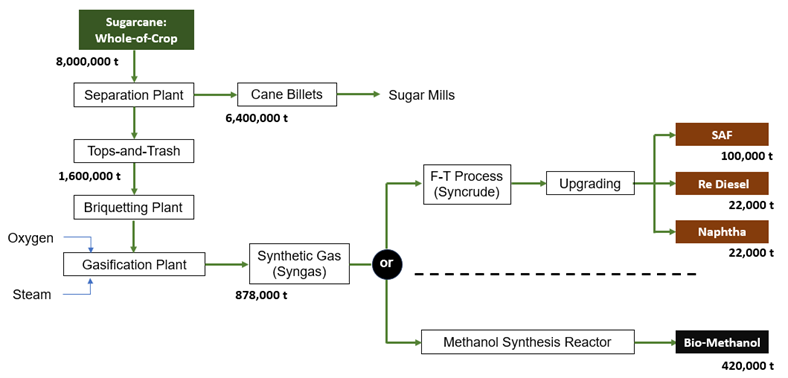
Project Lion in the Burdekin Region utilises sugarcane tops-and-trash and potentially sun hemp as a common fallow crop for processing into syngas and use the syngas to produce methanol or directly into renewable diesel and/or SAF using Fischer-Tropsch technology.
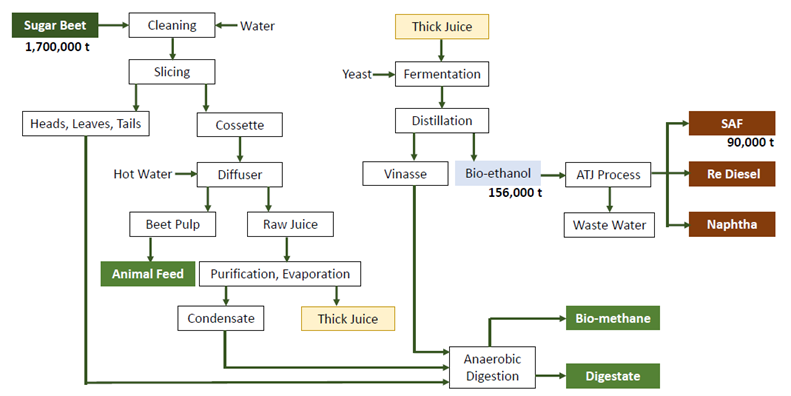
Project Feast in the Central Highlands Region utilises sugar “thick juice” extracted from sugar beet which is to be grown as a winter rotational crop to produce bioethanol for processing into SAF using alcohol-to-jet technology.
SKY Renewables has spent the last seven years working with over 500 growers in the Burdekin to convince them to stop cane-burning before harvest. The sugarcane tops-and-trash that is being burnt provides an excellent feedstock for gasification. Agricultural residue has a very low 7.7 Default Core LCA value, and a Default ILUC value of 0 under CORSIA. Stopping annual burning in the 80,000 hectares of cane farms in the Burdekin itself (equivalent to the size of Singapore) will avoid over 3,000,000 tons of CO2e and other GHG emissions.
In the case of Project Feast, SKY Renewables is working with eight of the largest cotton growers in the Emerald area of Central Queensland who collectively own and farm over 25,000 hectares of cotton fields to grow sugar beet as a winter rotational crop and utilise the “thick juice” for processing into bioethanol.
Project Lion can be scaled up to cover all the cane-growing regions in Queensland. There are, in addition, more than 70,000 hectares of land in Queensland which is suitable to grow sugar beet as a rotational crop. The potential in south-east Australia is even bigger.
On 8 October 2025, SKY Renewables signed a collaborative MOU with Honeywell UOP, a leading US multinational with 119 years of history and USD130 billion market capitalisation, to establish a highly unique Feedstock & Technology partnership. Honeywell UOP is a global leader in both alcohol-to-jet and Fischer-Tropsch technologies.
By working together, SKY Renewables and Honeywell UOP are demonstrating that the marriage of harnessable feedstock and world-leading technologies is the first big step in establishing, feasible, commercially viable and scalable SAF projects in Queensland and other parts of Australia.