

FedEx secures 20 million gallons of SAF at five US airports
New Releases:
IRS guidance affirms feedstock restrictions for US clean fuel tax credit
Canada backs CO2-to-ethylene SAF, green hydrogen projects with US$2.88 million
Montana Renewables renegotiates DOE loan as SAF project capital costs fall
American EcoFuels eyes Midland-Odessa SAF plant in Texas, airline offtake deals
S&P Global Energy Platts – Credit Stack SAF California
HIGHLIGHTS
FedEx expands SAF use to 20M gallons by 2027
Five major US airports receive fuel blends
Incentives enable alternative aviation fuel growth
FedEx has signed new sustainable aviation fuel procurement agreements projected to deliver more than 20 million gallons of neat SAF across five major US airports through 2027, as the courier giant accelerates its push to source 30% of its jet fuel from alternative sources by 2030.
The agreements cover FedEx operations at Newark Liberty International, Oakland International, Miami International, John F. Kennedy International and Dallas Fort Worth International airports, with SAF expected to be delivered at blend ratios ranging from 30% to 50% depending on location, the company said in a statement Sept. 15.
The expansion builds directly on an earlier procurement phase in which FedEx secured approximately 5 million gallons of neat SAF from 2025, resulting in the deployment of 16.5 million gallons of blended SAF across five US airports.
The new agreements represent a significant scaling of that effort, with SAF blends now accounting for a significant share of FedEx jet fuel use at the named airports, according to the company.
Greg Paulus, vice president of Enterprise Sourcing at FedEx, said in the statement that state and federal incentives had been a key enabler of the latest round of agreements. "The latest agreements represent an expansion of SAF within the FedEx air network enabled, in part, by state and federal level incentives," Paulus said.
Market implications
The procurement scale and geographic spread of the agreements carry implications for the broader US SAF supply market.
By committing to offtake across five major hub airports through 2027, FedEx is providing producers with a demand signal that extends beyond spot purchasing, a structure that industry participants have identified as critical to unlocking investment in new SAF production capacity.
Karen Blanks Ellis, chief sustainability officer and vice president of Environmental Affairs at FedEx, said in the statement that reliable and affordable supply remained the central constraint on SAF market growth. "SAF is one of the most impactful decarbonization solutions available to aviation today and an important part of our approach to reducing emissions," Blanks Ellis said. "For the market to grow, supply needs to be reliable, affordable, and sustainable. Expanding our procurement allows us to employ more SAF in our network while bolstering the demand for greater production and scale."
The five airports named in the agreements are among the busiest cargo gateways in the United States, with Dallas Fort Worth, Miami and Newark serving as major international freight hubs and Oakland functioning as a key West Coast logistics node.
The geographic diversity of the procurement spanning the US East Coast, South, and West Coast suggests FedEx is working to embed SAF supply across its core domestic network rather than concentrating uptake at a single location.
FedEx did not disclose the identity of the SAF suppliers involved in the new agreements, the specific feedstocks or production pathways used, or the per-gallon pricing terms. The company also did not specify whether the agreements are structured as fixed-volume offtake contracts or as volume-range commitments subject to supply availability.
The company said it would continue evaluating opportunities to expand SAF use where supply, infrastructure and economics aligned with the needs of its air network, signaling further procurement rounds are possible but stops short of committing to specific volumes or timelines beyond 2027.
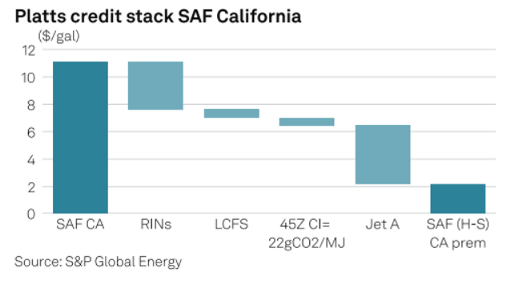
Platts, part of S&P Global Energy, assessed SAF California at 1,109.65 cents/gal and SAF (H-S) CA (credits det) at 651.83 cents/gal on Sept. 14, based on a spread of neat SAF to Jet Kero LA CA pipeline of 215.93 cents/gal. Platts considered SAF CIF NWE with transportation costs.
Would you like to learn more?
Author: Samyak Pandey | samyak.pandey@spglobal.com
Editor: Benjamin Morse | benjamin.morse@spglobal.com
© 2026 by S&P Global Energy, a division of S&P Global Inc. All rights reserved.
S&P Global, the S&P Global logo, S&P Global Energy, Platts, and Fertecon are trademarks of S&P Global Inc. Permission for any commercial use of these trademarks must be obtained in writing from S&P Global Inc.
You may view or otherwise use the information, prices, indices, assessments, content, analysis and other related information, graphs, tables and images (collectively, “Data”) in this report only for your personal and internal use or, if you or your company has a license for the Data from S&P Global Energy (“SPGE”) and you are an authorized user, for your company’s internal business use only. You may not publish, reproduce, extract, distribute, retransmit, resell, create any derivative work from and/or otherwise provide access to the Data or any portion thereof to any person (either within or outside your company, including as part of or via any internal electronic system or intranet), firm or entity, including any subsidiary, parent, or other entity that is affiliated with your company, without SPGE’s prior written consent or as otherwise authorized under license from SPGE. Any use or distribution of the Data beyond the express uses authorized in this paragraph is subject to the payment of additional fees to SPGE.
SPGE, its affiliates and all of their third-party licensors (i) disclaim any and all warranties, express or implied, including, but not limited to, any warranties of merchantability or fitness for a particular purpose or use as to the Data, or the results obtained by its use or as to the performance thereof; (ii) do not guarantee the adequacy, accuracy, timeliness and/or completeness of the Data or any component thereof or any communications (whether written, oral, electronic or other format), with respect thereto, and (iii) shall not be subject to any damages or liability, including but not limited to any indirect, special, incidental, punitive or consequential damages (including but not limited to, loss of profits, trading losses and loss of goodwill).
Data in this report includes independent and verifiable data collected from actual market participants. Users of the Data should not rely on any information and/or assessment contained therein in making any investment, trading, risk management or other decision.
ICE index data and NYMEX futures data used herein are provided under SPGE’s commercial licensing agreements with ICE and with NYMEX. You acknowledge that the ICE index data and NYMEX futures data herein are confidential and are proprietary trade secrets and data of ICE and NYMEX or its licensors/suppliers, and you shall use best efforts to prevent the unauthorized publication, disclosure or copying of the ICE index data and/or NYMEX futures data.
The Data in this report contains the results of SPGE’s independent research and analysis and is intended for general informational purposes only. The Data is not intended, and may not be used, to promote, directly or indirectly, the supply or use of any product or business interest, including, but not limited to, the benefits of any product, business, or business activity for protecting or restoring the environment or mitigating the causes or effects of climate change. No Data or opinions contained herein constitute a representation to the public with respect to the benefits of any product, business or business activity, and should not be relied on as a recommendation for any specific action to be taken.
Any queries or requests pursuant to this notice should be addressed to SPGE via email at Legalnotices.energy@spglobal.com