From Production Plant to Passenger Flight: German-Made e-SAF Enters Commercial Aviation

Tim Böltken
CEO and Co-Founder
-
INERATEC
A KLM Cityhopper flight between Amsterdam and Hamburg has demonstrated that synthetic aviation fuel produced from renewable hydrogen and CO₂ can already be integrated into regular passenger operations. The flight also underlined the urgent need to move from technical readiness to industrial-scale production.
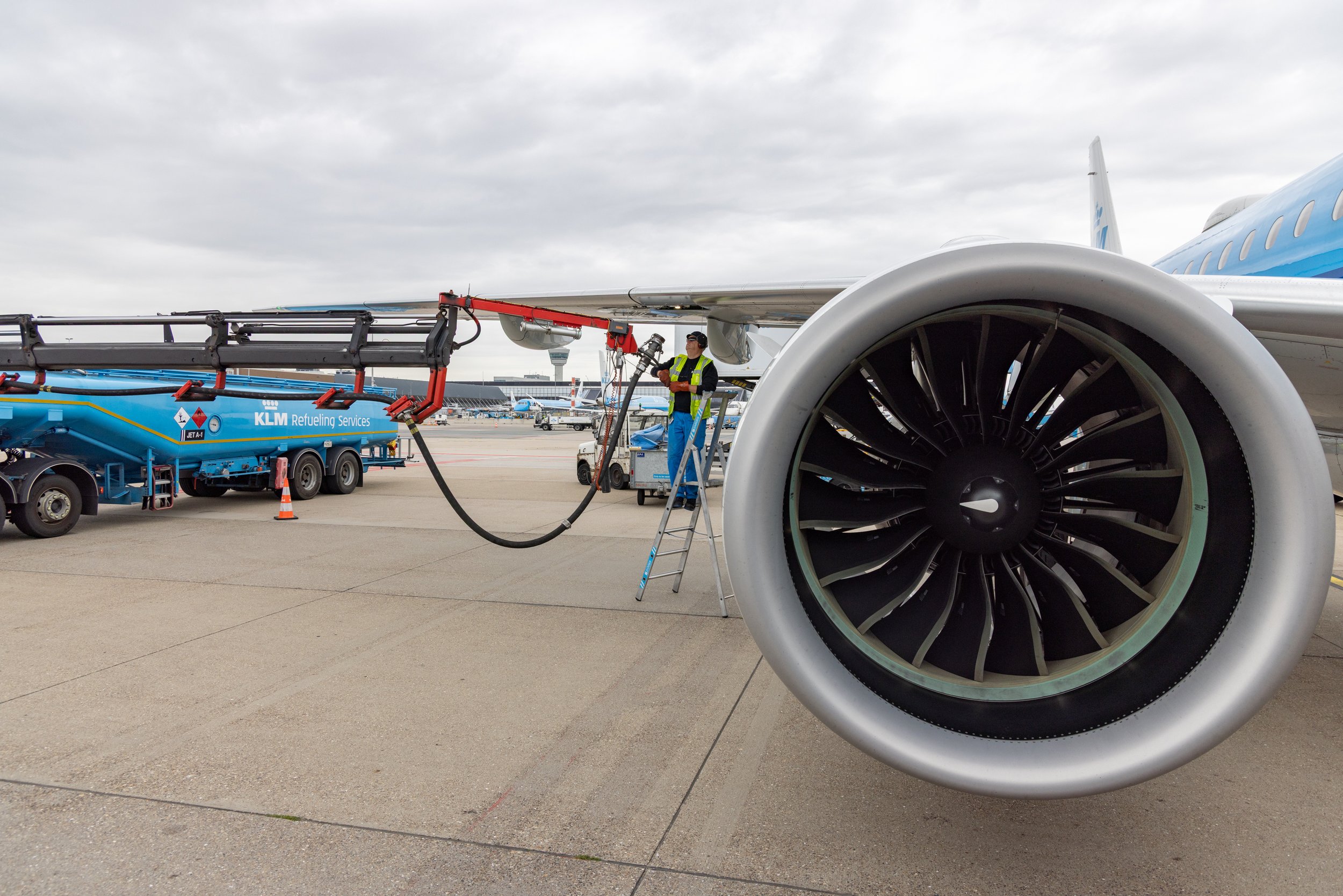
On 8 June 2026, a scheduled KLM Cityhopper passenger flight departed Amsterdam Schiphol Airport for Hamburg using a fuel blend containing synthetic kerosene produced in Germany. The demonstration, jointly organized by KLM Cityhopper, INERATEC, Hamburg Airport and MB Energy, marked the first passenger flight involving a synthetic kerosene blend of this kind in Germany.
Although the aircraft and airport operations appeared no different from those of a conventional commercial flight, the journey represented an important milestone for the European sustainable aviation fuel industry. It showed that synthetic aviation fuel, commonly referred to as e-SAF, can be produced, processed, blended, transported, refuelled and used within existing aviation infrastructure.
The synthetic component was produced from hydrogen and captured CO₂ at INERATEC’s ERA ONE Power-to-Liquid facility in Frankfurt, Germany. INERATEC also carried out the hydrotreatment of the product. It was subsequently distilled and blended by ASG Analytik-Service AG with conventional kerosene supplied by MB Energy before being delivered to Schiphol Airport for refuelling.
The project therefore covered the complete value chain – from the production of synthetic hydrocarbons to their final use in a scheduled passenger aircraft.
A real-world test of the e-SAF value chain
The significance of the flight extends beyond the volume of synthetic kerosene consumed. Demonstration flights provide an opportunity to validate how new fuels interact with the operational, logistical and regulatory systems of commercial aviation.
In this case, the fuel was handled using existing infrastructure and incorporated into routine flight operations. No modifications to the aircraft or airport fuel systems were required. This is one of the central advantages of synthetic kerosene: when produced and certified according to the relevant aviation fuel specifications, it can be blended with conventional jet fuel and used in today’s aircraft and fuel infrastructure.
The flight confirmed that the individual stages of the supply chain can work together under commercial conditions. Production, upgrading, quality control, blending, logistics and airport refuelling were coordinated across several companies and two countries.
For fuel distributors and infrastructure operators, the development of reliable supply routes will be essential as production volumes increase. MB Energy is therefore preparing infrastructure and routes to market for future fuels while maintaining the stable supply systems required by aviation customers.
Hamburg Airport also sees existing airport infrastructure as capable of supporting the introduction of alternative fuels.
From renewable electricity to synthetic kerosene
Synthetic kerosene is produced through Power-to-Liquid processes. Renewable electricity is used to generate hydrogen, which is combined with CO₂ to produce synthesis gas. This synthesis gas is then converted into synthetic hydrocarbons that can be refined into products such as aviation fuel.
The synthetic kerosene used for the KLM flight originated from INERATEC’s ERA ONE plant. The facility represents an important step from pilot-scale production towards the commercial manufacturing of e-Fuels and e-Chemicals in Europe.
INERATEC develops modular Power-to-X plants that convert renewable hydrogen and CO₂ into synthetic fuels and chemical products. The company’s approach is designed to allow production capacity to be deployed close to sources of renewable energy, hydrogen and CO₂, as well as near industrial customers and transport infrastructure.
Alternative synthetic kerosene can potentially reduce lifecycle greenhouse-gas emissions by up to 90% compared with conventional fossil kerosene, depending on factors such as the electricity source, the origin of the CO₂ and the configuration of the production process.
Technical feasibility is no longer the central question
For many years, discussions around e-SAF focused primarily on whether synthetic fuels could meet aviation’s demanding technical and safety requirements. Projects such as the KLM flight increasingly shift the focus towards a different question: how quickly can production be expanded?
The technology required to produce synthetic kerosene exists. The product can be blended with conventional fuel, distributed through existing supply chains and used in regular aircraft operations. However, current production volumes remain very small compared with the quantities consumed by European aviation.
The challenge is particularly visible in the context of the European Union’s ReFuelEU Aviation framework, which introduces progressively increasing requirements for sustainable aviation fuels and a dedicated sub-target for synthetic aviation fuels.
While a substantial pipeline of proposed e-SAF projects has emerged across Europe, only a limited number of facilities are currently producing fuel. Many announced projects have not yet reached final investment decision, and large-scale commercial production remains in its early stages.
This creates a potential gap between regulatory demand and physical supply. Project announcements suggest that future capacity could eventually exceed mandated demand, but those volumes will only become available if projects secure financing, permits, renewable electricity, hydrogen and long-term customers.
A significant number of investment decisions is expected by 2027. The coming years will therefore be decisive for determining whether Europe can translate its extensive project pipeline into operating production capacity.
Scaling requires cooperation across the market
The KLM flight demonstrated that no single company can establish an e-SAF market alone. Producers, airlines, fuel suppliers, airports, technology providers, investors and policymakers all have distinct roles within the value chain.
Airlines can create demand through long-term purchasing agreements. Producers must build and operate first-of-a-kind facilities. Fuel suppliers need to develop reliable logistics and blending capabilities. Airports must ensure that sustainable fuels can be incorporated into existing refuelling systems. Investors require sufficient certainty that projects will generate stable revenues over their operating life.
Governments also play a central role. Early e-SAF facilities face high capital costs, long permitting processes and uncertainty regarding future regulatory requirements. Targeted support mechanisms, faster approvals and predictable policy frameworks can help projects reach investment decision and reduce costs through replication and scale.
A milestone, not the destination
A single flight will not materially change aviation’s overall emissions. Its importance lies in demonstrating that the necessary technologies and supply-chain components are already capable of working together. The next phase must focus on repeating this process at a much larger scale.
For the e-SAF industry, the central task is no longer simply to prove that synthetic kerosene can be produced and flown. It is to build enough production capacity to make such flights routine rather than exceptional.
The technology is ready. The infrastructure can accommodate it. The remaining challenge is to mobilize the investment, policy support and long-term demand required to turn Europe’s growing e-SAF pipeline into an industrial market.