

David Schwalje, VP of Emerging Market Development, Axens
Joan Cetera, VP of Communications and PR, Gevo
Atul Mulay, President – Corporate Strategy, Praj Industries
Background
Sustainable Aviation Fuel project developers know well that delivering successful projects requires a complex alignment of policy, production cost gaps, project finance, creative contracting, technology, and execution. Today’s SAF producers have navigated that landscape to deliver a growing number of Final Investment Decisions, overwhelmingly utilizing the HEFA pathway via a mix of both revamp and grassroots projects.
The next wave of project FIDs will likely be comprised of the “all of the above” SAF strategy including First-Of-A-Kind (FOAK) Alcohol-to-Jet (ATJ), biogas-to-fuels, and biomass gasification + Fischer-Tropsch (F-T) projects.
The Project Development Gauntlet
Project developers face a unique challenge for this next wave of pathways: developing projects to the point of being bankable requires investing meaningful development capital in what can be called the development gauntlet, including significant engineering efforts and Engineering, Procurement, and Construction (EPC) learning curves, all deploying high-risk development capital – all of this in a development market that is highly sensitive to production costs and the resulting product pricing effects.
Partnering to Bring a Project Delivery Solution
Few know this project development investment gauntlet better than Gevo, whose commitment to deliver SAF utilizing low-cost carbohydrates has resulted in multiple FID-ready ATJ projects. Each project had a different execution strategy including modularization by Praj Industries. At the same time, Axens had multiple projects developing around the world using its Jetanol® ATJ technology, each at different production capacities and with markedly different EPC contractor design and pricing approaches.
What the teams realized is that there was a better way to deliver FOAK SAF projects by utilizing their collective experience and extensive databases of engineering work: develop a “copy/edit/paste” project delivery strategy.
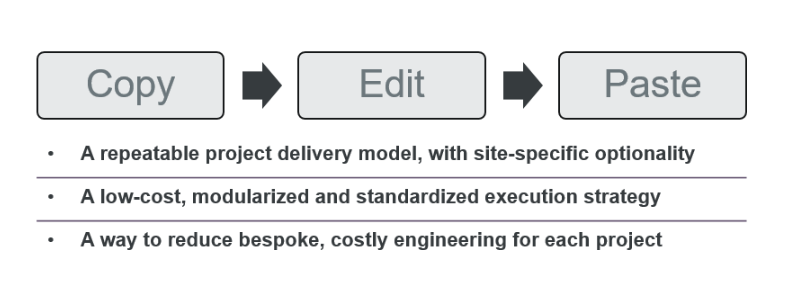
With that realization, a project delivery partnership was born to deliver:
Shorten the engineering and execution path, accelerating time to market,
lower re-engineering costs,
improve bankability,
and offer more standardized project execution – all while preserving design flexibility for a given project’s site constraints.
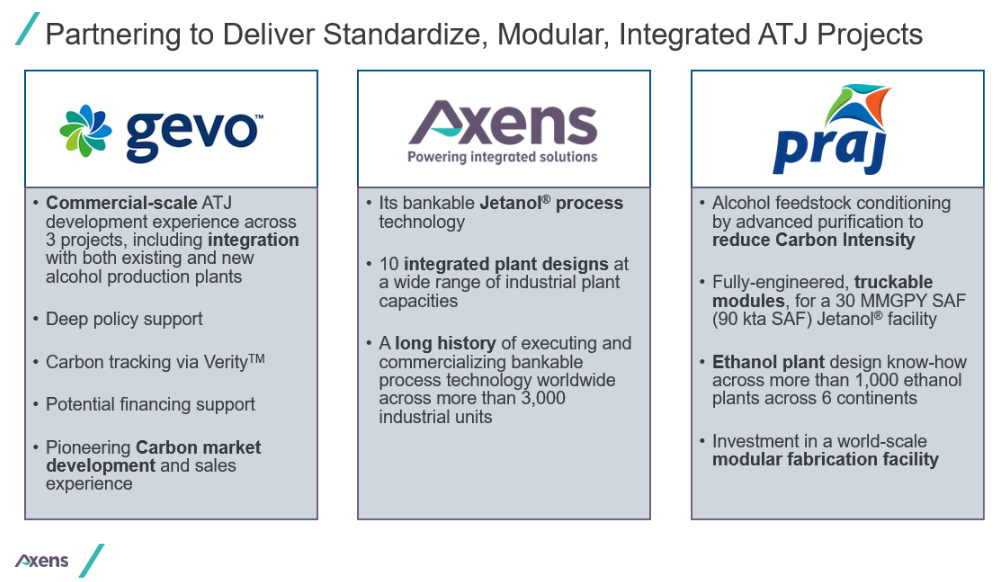
The partners also realized that not every project will benefit from a standardized project delivery approach, and they have all agreed to offer their respective legs of the stool on a “menu” basis, where projects can choose any, all, or none of the services from each partner. For example, a given project may only want to work with Gevo on policy support and carbon tracking but without Jetanol® technology or Praj modules, another may want to license the Axens Jetanol® process with a bespoke, stick-built design, and another may want to develop custom alcohol CI reduction solutions with Praj. The partners recognize that commercial and execution flexibility is critical in an emerging space, and, at the same time, the objective is to offer a low-cost, turnkey solution for developing projects that would benefit from a copy / edit / paste approach.
Closing Thoughts
In short,commercialization of SAF will require multiple pathways, execution partnerships can reduce time and cost to project readiness, standardized, flexible delivery models may help unlock more non-HEFA projects in this price-sensitive market.
Learn more at: