

New Releases:
California LCFS accepts ISCC EU as eligible certification scheme
India aims carbon emissions reporting for international flight amid 2027 SAF push
Singapore voluntary SAF trial completes first delivery ahead of national procurement rollout
Australia backs co-processed biofuels at refineries with new carbon rules
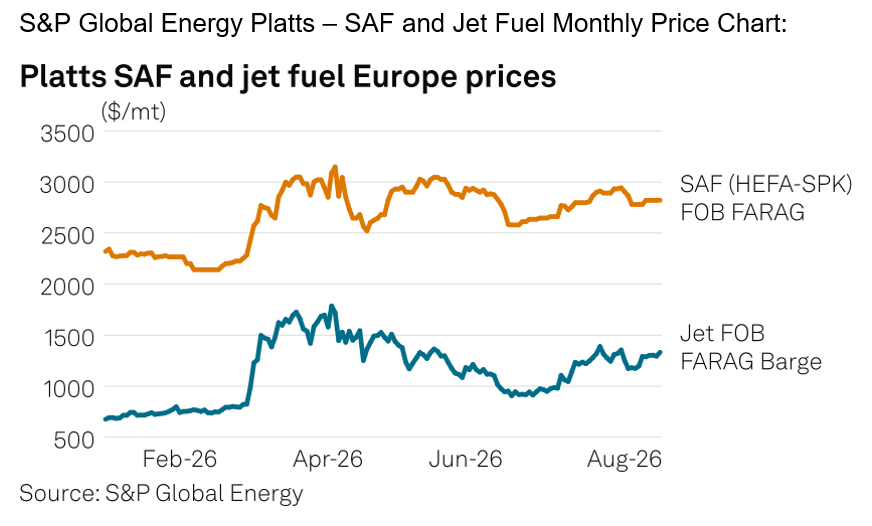
S&P Global Energy Platts – SAF and Jet Fuel Monthly Price Chart:
HIGHLIGHTS
ProBioQAV establishes SAF certification, book-and-claim mechanism
ANP, Anac given 240 days to issue implementing regulations
Government also establishes regulatory framework for CCUS
Brazil signed a decree on Aug. 12 regulating its National Sustainable Aviation Fuel Program, or ProBioQAV, establishing the rules for the country's SAF emissions-reduction mandate and creating what the government says is the world's first book-and-claim mechanism incorporated into public policy.
The SAF decree was one of four regulations signed by President Luiz Inácio Lula da Silva and Mines and Energy Minister Alexandre Silveira covering different areas of Brazil's energy transition. The other measures regulate carbon capture, utilization and storage, or CCUS, low-carbon hydrogen and the opening of the electricity market to low-voltage consumers.
The ProBioQAV regulation establishes rules covering SAF production, certification, commercialization and traceability, as well as compliance with greenhouse gas emissions-reduction targets for Brazil's domestic aviation sector.
Under Brazil's Fuel of the Future law, the targets will begin in 2027 and gradually increase to a 10% reduction in aviation emissions in 2037. Unlike a conventional volumetric blending mandate, the program establishes emissions-reduction requirements for airlines.
The decree also establishes the National Sustainable Aviation Fuel Certification Program, requiring certification of SAF produced domestically or imported into Brazil and providing for traceability of the fuel and its environmental attributes throughout the supply chain.
Brazil formalizes book-and-claim
Among the most significant provisions is the creation of the SAF Sustainability Certificate, or CS-SAF, based on a book-and-claim methodology.
The mechanism allows the environmental attribute associated with SAF to be traded separately from the physical fuel, potentially allowing SAF to be supplied where logistics and production economics are most favorable while its emissions-reduction attributes are transferred to another participant.
According to the government, the mechanism is designed to improve SAF's logistical viability, facilitate its use across Brazilian airports and provide a system for registering, tracing and verifying emissions reductions. Brazil will become the first country to adopt book-and-claim as the basis of a public policy for the sector, the Mines and Energy Ministry said.
The announcement confirms comments made earlier on Aug. 12 by Laís Forti Thomaz, chief of staff of the Ministry of Mines and Energy's National Secretariat for Petroleum, Natural Gas and Biofuels, during an energy industry event in São Paulo state.
"We are going to be the first country to have book-and-claim in a normative act," Thomaz said. "That is already settled; we managed to include it in the decree."
Thomaz also said the government was working with the Finance Ministry to establish a dedicated Mercosur Common Nomenclature, or NCM, classification for SAF, while participating in international discussions aimed at "greening the Harmonized System."
"SAF has to have differentiated tax treatment because it uses renewable biomass, and it has to receive that differentiation internationally as well," she said.
Brazil's oil regulator, ANP, and civil aviation regulator, Anac, will have 240 days to issue the complementary rules necessary to make ProBioQAV operational.
The government estimates Brazilian SAF production could reach 2.1 billion liters/year by 2030 and 3.6 billion liters/year by 2035. ProBioQAV alone could avoid more than 8 million metric tons of CO2 emissions over 10 years, while total SAF production could eventually reduce emissions by as much as 7.4 million metric tons/year, according to the Mines and Energy Ministry.
CCUS framework advances
A separate decree signed on Aug. 12 establishes conditions for carbon capture, pipeline transportation and geological storage activities in Brazil, regulating provisions of the 2024 Fuel of the Future law and creating a regulatory framework for CCS and CCUS projects.
The framework places the ANP in charge of authorizing activities through two stages: research and evaluation of potential storage areas, followed by operations. It also establishes requirements covering monitoring and the closure of storage projects.
The Mines and Energy Ministry, with support from state-owned energy research company EPE, will also develop a national infrastructure plan identifying and guiding the development of carbon capture, transportation and geological storage areas. The plan will be reviewed every two years.
The regulation encourages infrastructure sharing between projects through open-access, transparency and non-discrimination provisions, potentially supporting the development of multi-user CCUS hubs.
It also recognizes different carbon capture and storage technologies and requires operators to demonstrate the stability of stored CO2 before a project can be formally closed. Monitoring must continue for at least 20 years.
The CCUS framework could have particular relevance for Brazil's biofuels industry as producers explore carbon capture as an additional pathway to reduce the lifecycle carbon intensity of renewable fuels.
The government also signed regulations implementing Brazil's low-carbon hydrogen policy and opening the free electricity market to low-voltage consumers.
Separately, Brazil was confirmed this week as co-chair of the Council of the Global Biofuels Alliance alongside India. Brazil will also join Italy and Kenya on the organization's Executive Committee. The GBA, founded in 2023, comprises 34 countries and 14 international organizations and aims to expand biofuel production and consumption, market development, technical cooperation and sustainability initiatives.
Would you like to learn more?
Authors: Gabriela Brumatti gabriela.brumatti@spglobal.com | Vinicius Damazio vinicius.damazio@spglobal.com | Monique Murer monique.murer@spglobal.com | Ana Paula Candil ana.candil@spglobal.com
Editor: Marieke Alsguth | marieke.alsguth@spglobal.com
© 2026 by S&P Global Energy, a division of S&P Global Inc. All rights reserved.
S&P Global, the S&P Global logo, S&P Global Energy, Platts, and Fertecon are trademarks of S&P Global Inc. Permission for any commercial use of these trademarks must be obtained in writing from S&P Global Inc.
You may view or otherwise use the information, prices, indices, assessments, content, analysis and other related information, graphs, tables and images (collectively, “Data”) in this report only for your personal and internal use or, if you or your company has a license for the Data from S&P Global Energy (“SPGE”) and you are an authorized user, for your company’s internal business use only. You may not publish, reproduce, extract, distribute, retransmit, resell, create any derivative work from and/or otherwise provide access to the Data or any portion thereof to any person (either within or outside your company, including as part of or via any internal electronic system or intranet), firm or entity, including any subsidiary, parent, or other entity that is affiliated with your company, without SPGE’s prior written consent or as otherwise authorized under license from SPGE. Any use or distribution of the Data beyond the express uses authorized in this paragraph is subject to the payment of additional fees to SPGE.
SPGE, its affiliates and all of their third-party licensors (i) disclaim any and all warranties, express or implied, including, but not limited to, any warranties of merchantability or fitness for a particular purpose or use as to the Data, or the results obtained by its use or as to the performance thereof; (ii) do not guarantee the adequacy, accuracy, timeliness and/or completeness of the Data or any component thereof or any communications (whether written, oral, electronic or other format), with respect thereto, and (iii) shall not be subject to any damages or liability, including but not limited to any indirect, special, incidental, punitive or consequential damages (including but not limited to, loss of profits, trading losses and loss of goodwill).
Data in this report includes independent and verifiable data collected from actual market participants. Users of the Data should not rely on any information and/or assessment contained therein in making any investment, trading, risk management or other decision.
ICE index data and NYMEX futures data used herein are provided under SPGE’s commercial licensing agreements with ICE and with NYMEX. You acknowledge that the ICE index data and NYMEX futures data herein are confidential and are proprietary trade secrets and data of ICE and NYMEX or its licensors/suppliers, and you shall use best efforts to prevent the unauthorized publication, disclosure or copying of the ICE index data and/or NYMEX futures data.
The Data in this report contains the results of SPGE’s independent research and analysis and is intended for general informational purposes only. The Data is not intended, and may not be used, to promote, directly or indirectly, the supply or use of any product or business interest, including, but not limited to, the benefits of any product, business, or business activity for protecting or restoring the environment or mitigating the causes or effects of climate change. No Data or opinions contained herein constitute a representation to the public with respect to the benefits of any product, business or business activity, and should not be relied on as a recommendation for any specific action to be taken.
Any queries or requests pursuant to this notice should be addressed to SPGE via email at Legalnotices.energy@spglobal.com