

Delta, Shell expand SAF partnership at US hubs in five-year agreement
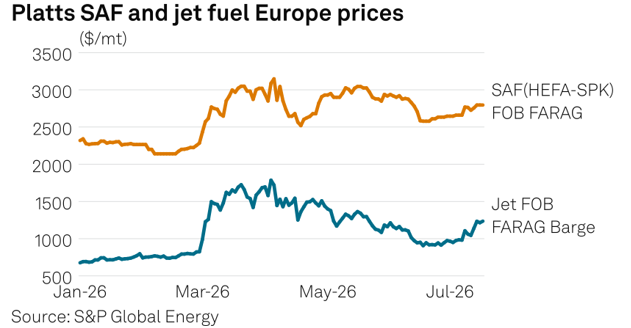
S&P Global Energy Platts – SAF and Jet Fuel Monthly Price Chart:
HIGHLIGHTS
Agreement expands SAF to five major US hubs
Infrastructure supports Delta's 2030 goals
Delta Air Lines has signed a five-year agreement with Shell Aviation to expand sustainable aviation fuel supply across multiple US airports through 2030, building infrastructure to support consistent SAF delivery as the carrier advances decarbonization efforts, the airline said in a July 15 statement.
The partnership will expand SAF availability at key Delta hubs and priority cities, including Los Angeles, New York's JFK, Boston, Minneapolis-St. Paul and Portland, with Shell supporting the blending, logistics and distribution infrastructure needed to integrate SAF into day-to-day operations.
The agreement builds on existing SAF initiatives between the companies and decades of collaboration on conventional jet fuel supply.
The deal underscores the aviation industry's push to scale SAF adoption amid constraints from limited production and high costs. Airlines increasingly view long-term supply agreements and infrastructure investments as critical to securing reliable SAF availability while advancing industrywide decarbonization goals, with sustainable fuel seen as the most immediate pathway to lowering aviation emissions.
Infrastructure focus
Shell will support both blended and neat SAF deliveries at select hubs and priority cities, establishing the logistics, blending and distribution capabilities required for dependable supply across Delta's network. The infrastructure-first approach aims to ensure SAF can scale with demand while maintaining operational reliability.
"Current instability and uncertainty have made one thing very clear to consumers and businesses alike -- supply diversity matters," Amelia DeLuca, Delta's chief sustainability officer, said. "With Shell, we're proving that scaling SAF isn't theoretical, it's achievable. This is about activating real supply chains at scale and creating a model that others can build on as we work across the industry to expand lower-impact travel."
The collaboration will also explore next-generation fuel technologies, including alcohol-to-jet and power-to-liquid pathways, to unlock additional supply and further reduce life cycle emissions over time.
"This collaboration delivers on today's fuel needs and tomorrow's aviation solutions," Reema Bari, head of aviation Americas at Shell, said. "By supplying conventional jet, SAF and longer-term innovation, the deal will help strengthen energy security and contribute to the transformation of aviation."
Building on momentum
The agreement builds on Delta's broader SAF momentum, including its role as an anchor partner in the Minnesota SAF Hub coalition, which aims to scale SAF production and replace conventional jet fuel.
In 2024, two shipments of 7,000-plus gallons of SAF arrived at the Minneapolis-St. Paul International Airport and the Detroit Metropolitan Airport, marking the first time in Minnesota and Michigan aviation history that SAF was delivered to those airports.
Delta achieved a key milestone in September 2025 by taking delivery of more than 400,000 gallons of SAF at Portland International Airport in partnership with Shell, marking the first commercial-scale uplift of SAF at the airport.
The neat SAF was shipped to Portland's Zenith Terminal, blended with traditional jet fuel to meet regulatory requirements, then delivered to the airport via barge, truck and pipeline before entering the fuel system.
Delta and Shell previously said a two-year agreement in April 2023 for Shell to supply up to 10 million gallons of neat SAF to Delta's Los Angeles hub, increasing the airline's SAF commitments to over 200 million gallons.
That agreement also included testing Avelia, a blockchain-powered digital SAF solution launched by Shell and partners, to track SAF delivery and use data with full transparency while avoiding issues such as double-counting.
Delta aims to achieve net-zero emissions by 2050, with the company noting that roughly 90% of its carbon emissions come from jet fuel, making SAF a key element of its decarbonization efforts.
The carrier targets SAF comprising 10% of its fuel use annually by the end of 2030 and 35% by 2035, subject to third-party investment and timely facility development.
The life cycle carbon emissions of producing neat SAF can be up to 80% lower than those of traditional jet fuel, according to Delta.
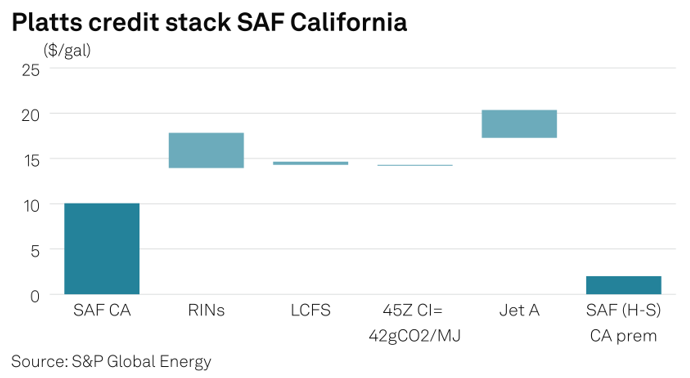
Platts, part of S&P Global Energy, assessed SAF California at 1,042.15 cents/gallon and assessed SAF California, withcredits detached, at 539.10 cents/gal on July 14. Platts assessed ATF 30/70 prices in California at 528.68 cents/gal. Platts assessed SAF Illinois at 1,144.45 cents/gal and assessed SAF Illinois, with credits detached, at 546.35 cents/gal, based on an indicative premium of neat SAF to jet kerosene Chicago Pipeline of 201.42 cents/gal.
Would you like to learn more?
Author: Samyak Pandey | samyak.pandey@spglobal.com
Editor: Marieke Alsguth | marieke.alsguth@spglobal.com
© 2026 by S&P Global Energy, a division of S&P Global Inc. All rights reserved.
S&P Global, the S&P Global logo, S&P Global Energy, Platts, and Fertecon are trademarks of S&P Global Inc. Permission for any commercial use of these trademarks must be obtained in writing from S&P Global Inc.
You may view or otherwise use the information, prices, indices, assessments, content, analysis and other related information, graphs, tables and images (collectively, “Data”) in this report only for your personal and internal use or, if you or your company has a license for the Data from S&P Global Energy (“SPGE”) and you are an authorized user, for your company’s internal business use only. You may not publish, reproduce, extract, distribute, retransmit, resell, create any derivative work from and/or otherwise provide access to the Data or any portion thereof to any person (either within or outside your company, including as part of or via any internal electronic system or intranet), firm or entity, including any subsidiary, parent, or other entity that is affiliated with your company, without SPGE’s prior written consent or as otherwise authorized under license from SPGE. Any use or distribution of the Data beyond the express uses authorized in this paragraph is subject to the payment of additional fees to SPGE.
SPGE, its affiliates and all of their third-party licensors (i) disclaim any and all warranties, express or implied, including, but not limited to, any warranties of merchantability or fitness for a particular purpose or use as to the Data, or the results obtained by its use or as to the performance thereof; (ii) do not guarantee the adequacy, accuracy, timeliness and/or completeness of the Data or any component thereof or any communications (whether written, oral, electronic or other format), with respect thereto, and (iii) shall not be subject to any damages or liability, including but not limited to any indirect, special, incidental, punitive or consequential damages (including but not limited to, loss of profits, trading losses and loss of goodwill).
Data in this report includes independent and verifiable data collected from actual market participants. Users of the Data should not rely on any information and/or assessment contained therein in making any investment, trading, risk management or other decision.
ICE index data and NYMEX futures data used herein are provided under SPGE’s commercial licensing agreements with ICE and with NYMEX. You acknowledge that the ICE index data and NYMEX futures data herein are confidential and are proprietary trade secrets and data of ICE and NYMEX or its licensors/suppliers, and you shall use best efforts to prevent the unauthorized publication, disclosure or copying of the ICE index data and/or NYMEX futures data.
The Data in this report contains the results of SPGE’s independent research and analysis and is intended for general informational purposes only. The Data is not intended, and may not be used, to promote, directly or indirectly, the supply or use of any product or business interest, including, but not limited to, the benefits of any product, business, or business activity for protecting or restoring the environment or mitigating the causes or effects of climate change. No Data or opinions contained herein constitute a representation to the public with respect to the benefits of any product, business or business activity, and should not be relied on as a recommendation for any specific action to be taken.
Any queries or requests pursuant to this notice should be addressed to SPGE via email at Legalnotices.energy@spglobal.com